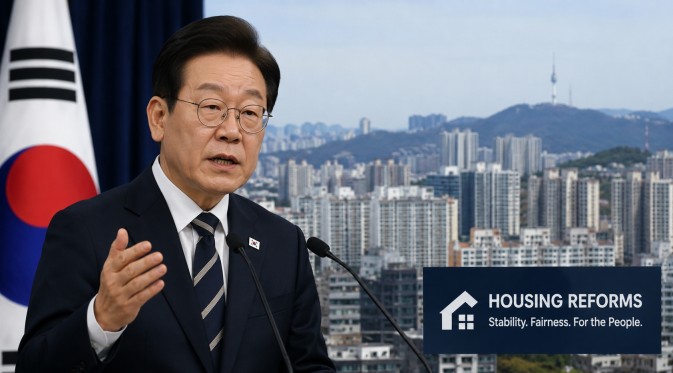
South Korean President Lee Jae Myung has committed to advancing significant housing reforms, emphasizing the need to address the escalating property bubble that threatens to induce a prolonged economic stagnation akin to Japan’s post-bubble scenario. Speaking at a recent policy forum, Lee highlighted the urgency of implementing measures such as increased property holding taxes, adjusted capital gains taxes, and more stringent mortgage lending rules to curb market speculation and stabilize the housing sector.
Lee’s strategy involves a nuanced approach aimed at safeguarding single-home owners, low-income families, and residents living outside the capital region. In contrast, it seeks to impose greater tax liabilities on those owning multiple homes or high-value speculative properties. Additionally, he advocated for stricter limitations on rental-deposit loans, while proposing exemptions for young individuals, newlyweds, and other vulnerable demographics to ease their financial burdens.
The president underscored the necessity of these challenging reforms for ensuring South Korea’s long-term economic stability. He asserted that the government must be prepared to face the political repercussions that might arise from these measures to avert a more severe economic crisis down the line. Lee’s administration is expected to reveal a comprehensive real estate policy package either later this month or by early August, detailing the proposed reforms.
Despite the potential for political resistance, Lee remains resolute in his stance that these reforms are critical for the nation’s future. The proposed changes reflect his administration’s dedication to preventing the economic pitfalls associated with unchecked property market growth, thereby securing a more stable and sustainable economic path for South Korea.