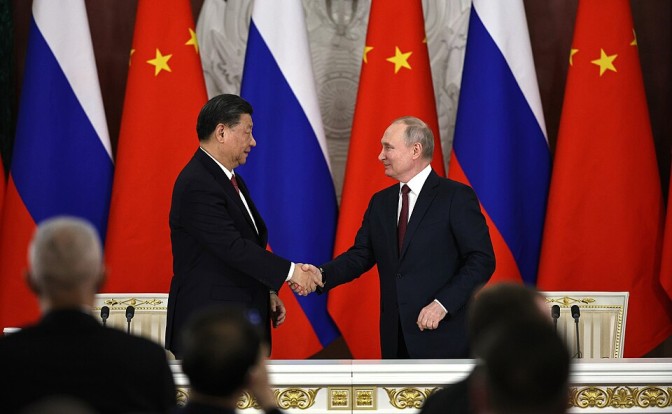
In a significant diplomatic development, Chinese President Xi Jinping and Russian President Vladimir Putin agreed on Wednesday to extend the China-Russia Treaty of Good-Neighborliness and Friendly Cooperation. The decision, made during discussions in Beijing’s Great Hall of the People, underscores the commitment of both nations to bolster political mutual trust, strategic coordination, and practical cooperation amidst current global uncertainties. This meeting marked Putin’s 25th visit to China since he first took office in 2000, highlighting the depth and uniqueness of the relationship between the two countries.
The discussions culminated in the signing of a joint statement aimed at enhancing comprehensive strategic coordination. Both leaders witnessed the signing of 20 cooperation documents spanning various fields such as economy, trade, education, and science and technology. Additionally, a joint statement was issued advocating for a multipolar world and a new type of international relations. The bilateral ties, which have reached unprecedented levels over the past three decades, serve as a model for major-country relations, according to Xi, who emphasized that this year marks the 30th anniversary of the China-Russia strategic partnership.
Xi stressed the importance of maintaining close strategic communication and consolidating political mutual trust. He noted that the two countries have consistently adhered to the treaty’s principles of non-alliance, non-confrontation, and non-targeting of third parties, contributing significantly to international fairness and justice. The value of bilateral trade between China and Russia has remained robust, exceeding $200 billion for three consecutive years, with a nearly 20 percent increase observed in the first four months of 2026 alone.
Putin, who received a ceremonial welcome including a 21-gun salute, expressed his confidence in the future of Russia-China relations. He committed to deepening the partnership and good-neighborly friendship, emphasizing that their relations are self-sufficient and independent of the current international landscape. He highlighted the joint responsibility of both nations, as permanent members of the UN Security Council, to uphold international law and oppose unilateral actions that threaten global stability.
During their talks, Xi and Putin exchanged views on pressing international issues, including the Middle East situation, where Xi called for an immediate cessation of hostilities. Both countries committed to extending their visa-free policies for each other’s citizens until the end of 2027, fostering greater people-to-people exchanges. As the China-Russia relationship enters a new stage of accelerated growth, Xi emphasized the need to fully implement their shared understandings and explore new avenues for cooperation in areas like trade, energy, and technology, while also strengthening cultural and educational ties.