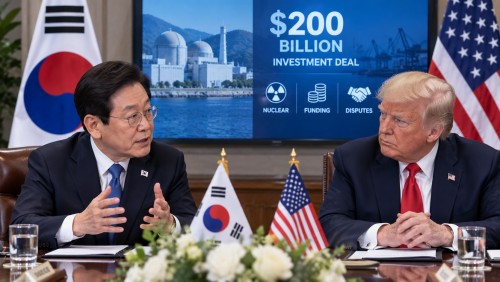
The future of a $200 billion investment commitment by South Korea into the U.S. remains uncertain as the two nations grapple with unresolved issues surrounding nuclear projects, financial timelines, and investment risks. With significant economic implications at stake, the ongoing negotiations could impact both countries’ energy and industrial strategies.
Central to the discussions is the disagreement over nuclear reactor designs, which are pivotal to South Korea’s proposed $120 billion allocation for nuclear-related projects. The debate centers on constructing eight reactors in the U.S., including six based on Westinghouse’s AP1000 design and two using South Korea’s APR1400 technology. However, U.S. officials and Westinghouse have resisted including the Korean-designed APR1400, complicating the nuclear agreement.
Further complicating matters, South Korea is pushing for a substantial stake in Westinghouse, seeking a 15% to 20% ownership along with voting rights and a board seat. Westinghouse, however, aims to limit this stake to below 10%. These ownership negotiations are critical as they could influence the control and direction of future nuclear technology collaborations.
Another contentious issue involves the funding schedules proposed by each country. The U.S. has requested over $9 billion from South Korea by the end of the year, contrasting with Seoul’s initial plan to provide a smaller amount in 2026 and increase investments from 2027. This difference in financial timelines adds another layer of complexity to finalizing the investment framework.
Investment return calculations are also under debate, with South Korea advocating for profits from successful projects to offset losses from unsuccessful ones. The U.S. prefers a separate calculation for each project, which could lead to disproportionate financial outcomes. Under current discussions, the U.S. would receive 90% of net profits after principal and interest recovery, a point of concern for South Korea given the potential for uneven risk distribution.
Despite these challenges, both governments remain engaged in negotiations to finalize the details of the investment package. The South Korean Industry Ministry has emphasized that no final decisions have been made, keeping the door open for continued dialogue and potential breakthroughs in this high-stakes international collaboration.